
Author: Wu Wan-Ling 吳婉淩
In my memory, she is a strong, independent, well-educated, and deeply cultivated woman. Her short hair is always neat and tidy, the ends slightly curled, reflecting the morning sunlight with a soft, gentle glow. Her smile is never showy, yet it carries a calming strength that puts people at ease. Her rounded, full figure is her most distinctive and recognizable feature.
She always wears simple, understated clothing. There are no designer handbags or luxury labels to accent her appearance, yet one can still feel her resilient strength and gracious gentleness. With her hair simply held back by a headband, this is her most everyday look.
The image that left the deepest impression on me is seeing her figure in the park. Morning sunlight filters through the treetops, casting dappled shadows. Though already over seventy, she still carries a heavy backpack, her steps slow yet steady. A light breeze passes by; she stops, lifts her head, and gazes at the towering old trees. In that moment, her silhouette is illuminated by the sunlight, warm and strong.
Watching her persist in keeping the shop open despite illness, I feel both heartache and admiration. That passion for life is like a lamp, giving me the strength to rise again when I face difficulties.
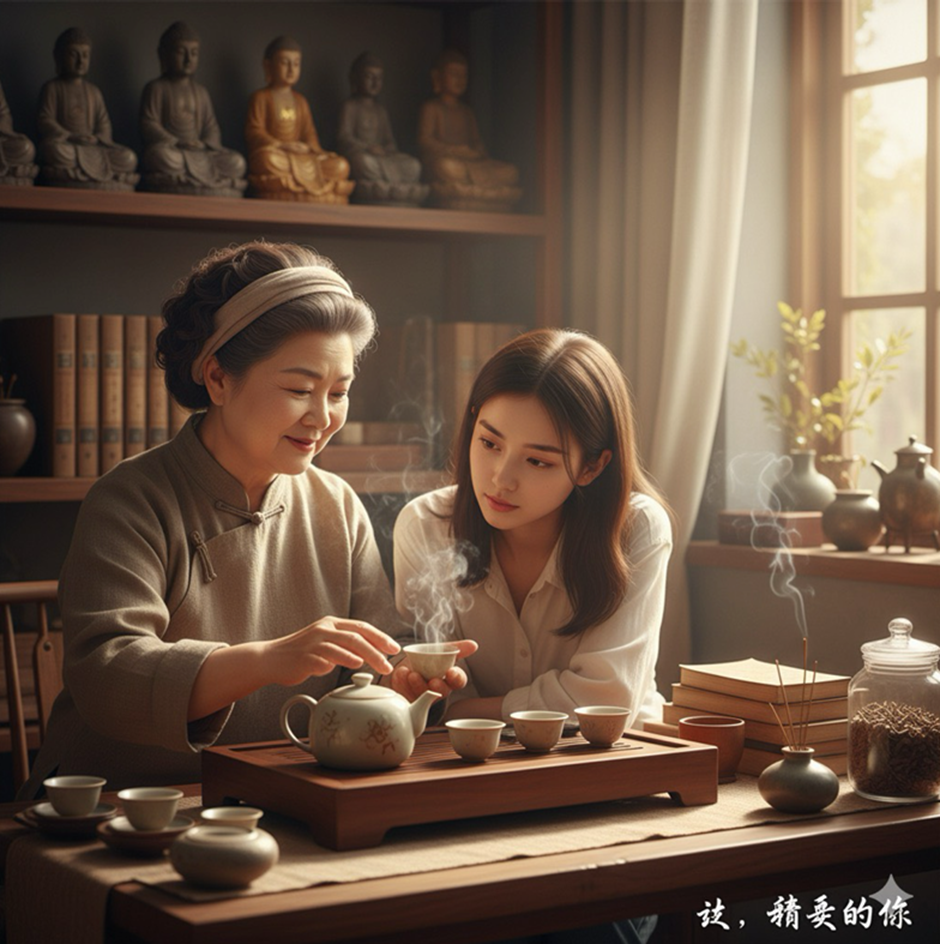
She has many interests. She loves brewing tea and once taught me how to prepare it by hand. Her movements while making tea are always practiced and firm, as the fragrance of tea and sandalwood lingers in the air. In those moments, I seem to see her attitude toward life, steadfast and generous, serious and resolute, always maintaining her own rhythm.
Together with my grandfather, she runs a tea shop. Inside the shop are collections of Buddha statues, Buddhist scriptures, and prayer beads, and the air is constantly filled with a simple, tranquil scent of sandalwood. Having studied Buddhism for many years, she is also a lecturer at a Buddhist Hall. When she speaks, her voice is clear and powerful, eloquently sharing insights gained from years of reading and reflection. She writes her lectures by hand, and between the lines one can feel her wisdom and refinement.
She is skilled in many things, writing, reading, cooking, almost nothing she cannot do. Among all her dishes, the one that left the deepest impression on me is the traditional Hakka stir-fried dish she cooks herself. The fragrant, chewy squid, springy and full of texture, is the flavour our family looks forward to most during festivals. What moves me deeply is that although Grandma herself follows a vegetarian diet, she is still willing to cook meat dishes by hand for the family, allowing everyone to enjoy a meal prepared with her care.
The spirit of traditional Hakka women is fully embodied in her. To me, she is a great figure who safeguards Hakka culture and values. She often talks with me about her younger years and how she faced life’s hardships, an unyielding perseverance that has carried through to the present. In her daily life, she continues to face everything with the same attitude; no matter how fierce the storms, she manages to endure them one by one.
She is the woman I admire most. Now seventy-six years old, she still maintains a “slash career” spirit, embodying the diligence, endurance, and resilience of Hakka women. Even though her health fluctuates and she often goes in and out of hospitals, she still chooses to wake early to work. After seeing the doctor, she returns to the shop and continues her tasks. This sense of responsibility fills me with deep respect, because she firmly believes that “living seriously is the most important thing.”
She often tells me, “Family is the center of everything. After you grow up, no matter how busy work gets, you must remember to care about your family.”
Now, I often think of that strong and generous woman. She is not only a role model in my life, but also an eternal light in my heart. From her, I learned the courage to move forward against the wind. She taught me that no matter what difficulties I encounter, I must believe that I am capable.
These words still echo in my heart today. Whenever I feel lost, I think of her, reminding myself to stay strong and to move forward bravely.
記憶中的她,是一位堅強、獨立、知書達禮且富有內涵的女性。短髮總是整齊
俐落,髮梢微微捲起,映著早晨的陽光閃著柔亮的光澤。她的笑容不張揚,卻
帶著一種安定人心的力量。圓潤飽滿的身材,是她最鮮明的標誌形象。
她總是穿著樸素淡雅的衣裝,沒有任何名牌包包或服飾的加持,卻能讓人感受
到她那堅韌有力量、又大氣溫婉的氣質。簡單梳起髮箍,這便是她最日常的裝
扮。
我印象最深刻的畫面,是在公園裡看見她的身影。早晨的陽光透過樹梢斑駁灑
落,年過七十的她仍背著厚重的後背包,步伐緩慢而堅定。微風拂過,她停下
腳步,仰望年邁的大樹。那一刻,她的背影被陽光照亮——溫暖又堅強。
看著她在病痛間仍堅持開店的身影,我心中既心疼又敬佩。那份對生活的熱
愛,像一盞燈,激勵了我在面對困難時重新振作的力量。
她擁有許多興趣。喜愛泡茶的她,曾教我親手泡茶。她泡茶的動作總是熟練且
堅定,茶香與檀香縈繞在空氣中。我彷彿看見她對待人生的態度——堅持與大
氣,認真且堅定,始終保有自己的節奏。
她與阿公共同經營著一間茶葉店。店裡收藏著各式各樣的佛像、佛經與珠寶,
空氣中總是瀰漫著古樸清幽的檀香氣息。學佛多年的她,同時也是一位佛堂講
師。講課時,她聲音鏗鏘有力,侃侃而談自己飽讀詩書後的心得,並親筆撰寫
成文,字裡行間充滿智慧與修養。
她的專長很多——寫作、閱讀、做菜,幾乎無所不能。其中,令我印象最深刻
的菜餚,是她親手烹調的傳統客家小炒。那香氣四溢、口感Q彈有嚼勁的炒魷
魚,是每逢年節家人們最期待的味道。令人感動的是,阿婆雖然自己吃素,卻
仍願意為家人親手煮葷食,讓大家吃上一口她用心準備的飯菜。
傳統客家女性的精神,在她身上展露無遺。對我而言,她是守護客家精神的大
人物。她常與我聊起年輕時的自己,如何面對生活的苦難——那份堅忍不拔的
心態,延續到了現在。日常生活中,她依然以這樣的態度面對任何事情,不論
大風大浪,都能一一挺過。
她是我最佩服的一位女性。如今七十六歲的她,依舊保持著「斜槓」的職業精
神,展現勤奮、刻苦、耐勞的客家女人形象。即使身體狀況時好時壞,時常進
出醫院,她仍選擇早起工作。看完醫生後,依舊回店裡繼續忙碌。這種責任
感,讓我深深敬佩——因為她深知:「認真生活,才是最重要的。」
她常告訴我:「家是一切的重心。長大後,就算工作再忙,也要記得關心家
人。」
如今,我總會想起那位堅強、大氣的女人——她不僅是我生命中的榜樣,更是
我心中永遠的光。從她身上,我學會了逆風前行的勇氣。她讓我明白,無論遇
到什麼困難,都要相信自己做得到。
這些話,至今仍在我心中迴響。每當我感到迷惘時,總會想起她,提醒自己—
—要堅強,並勇敢向前。