
Author: Huang Shuling 黃舒翎
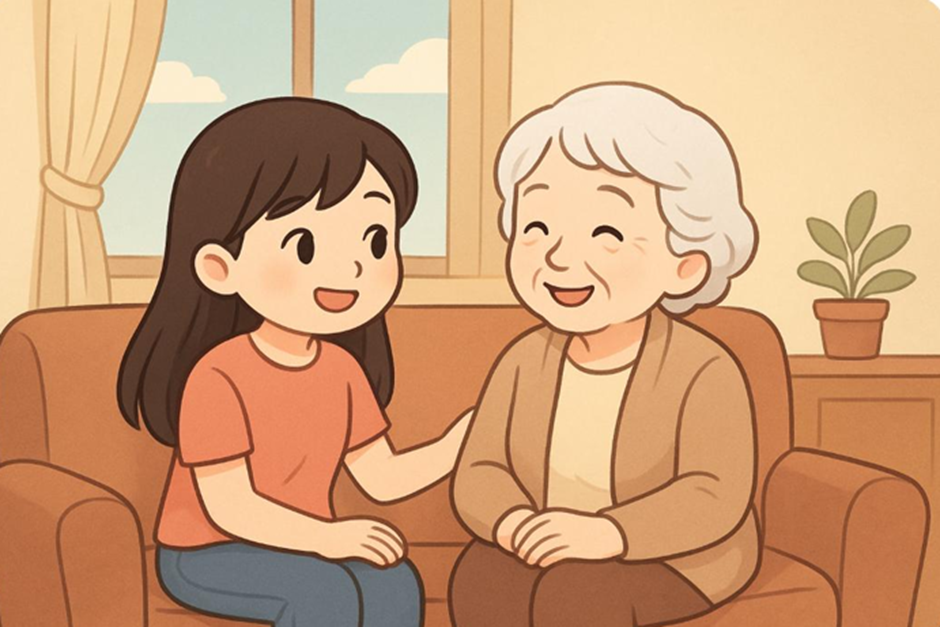
The person I interviewed this time is my lovely grandma. She is already eighty-eight years old! Although she is elderly, seeing her smile always makes me happy. She is always smiling, very much like the Laughing Buddha. Every time I walk through the door, she immediately asks me, “Are you hungry? Do you want a fried egg? Grandma will make one for you.” The tone of her voice is the same as when I was little, and it always makes my heart feel warm.
Grandma is a very hardworking and loving person. She loves cooking the most, especially fried pork strips and capelin fish. Because capelin is my favorite food, every time she goes to the market, she always buys a big bag especially for me, simply because she knows I like it. She always says, “Grandma is happy as long as I see you eat until you’re full.” These words sound simple, but they always move me deeply.
Once, I had an assignment for my home economics class to learn how to cook a homestyle dish. The first person I thought of asking was my grandma. That day, as she taught me, she also told me how she learned to cook when she was young. The kitchen that day was not only filled with the aroma of fried pork strips, but also with Grandma’s laughter. Although the dish I made still didn’t taste quite right, Grandma smiled and said, “For a first try, it’s already very good!” That whole process became a memory I cherish deeply.
However, in recent years, Grandma has begun to become a little forgetful. The family has grown worried and gradually stopped letting her go into the kitchen to cook. Although she smiles on the surface, I can tell that she is actually a little sad. Cooking, to her, is not just something she enjoys; it is a habit, and more importantly, a way of loving her family. From the time she married in her early twenties, she cooked for her family every single day. Now that she can no longer cook with her own hands, it feels as though a part of her life has been taken away.
Grandma grew up in poverty. She was the eldest daughter in the family, with several younger brothers and sisters. She did very well in school, and her teacher once said she could continue her studies. She was very happy. However, she had no choice but to give up her education. For the sake of her younger siblings, she went to Taipei to work and earn money, and she had to send money back home to support the family. At that time, she was only twenty years old, yet she had already learned how to shoulder responsibility. She often tells me, “You must study hard, so you won’t have to suffer in the future.” When she says this, there is a hint of melancholy in her eyes, but even more so, a sense of longing.
I often feel that women of my grandma’s generation were truly strong. They rarely had the opportunity to think about what they themselves wanted. Most of the time, they lived for their families. But perhaps because of this, their love is especially genuine and deep. Grandma has used her entire life to show what “motherly love” really means, not through grand words, but through a bowl of soup and a plate of food prepared day after day.
Now, although her memory is not as good as it used to be, she still cares deeply about us. As soon as I appear, she wants to feed me, reminds me to take care of my health, and tells me to study hard.
Through this interview, I have come to understand Grandma’s life more deeply, and I have also rethought the meaning of “family” and “love.” Grandma’s life may not have been filled with remarkable achievements, but it has been full of giving and warmth. She has taught me that a person’s value does not lie in what they possess, but in how much love and strength they can give to others. She is the most stable presence in our family, and a light that will never go out.
我這次訪談的對象是我可愛的阿嬤,她今年已經八十八歲了!雖然年紀大,但
每次看到她的笑容就很開心,她總是笑笑的很像彌勒佛,每次我一走進家門,
她都會立刻問我:餓了嗎?要不要吃荷包蛋?阿嬤煎給你吃啊,那種語氣,就
像小時候一樣讓人心裡暖暖的。
阿嬤是一個非常勤勞、也非常有愛心的人,她最喜歡煮菜,尤其是炸豬肉條和
柳葉魚。因為柳葉魚是我特別喜歡的食物,每次去市場買菜,她總會特別買一
大包回來給我,只因為她知道那是我喜歡吃的,她說:阿嬤看到你吃飽就開
心。這句話聽起來簡單,卻總讓我覺得很感動。
以前我有一份中餐課的作業,要學一道家常菜,我第一個想到的就是找阿嬤。
那天,她一邊教我、一邊跟我說她年輕時怎麼學做菜的,那天的廚房不只充滿
著豬肉條的香氣,也充滿著阿嬤的笑聲。雖然最後我做出來的味道還是差了
點,但阿嬤還是笑笑說第一次很好吃了啦!那段過程也成了我非常珍惜的回
憶。
不過這幾年,阿嬤開始有點健忘,家裡的人也擔心她,慢慢不讓她進廚房煮菜
了,她雖然表面笑笑的,但我看得出來她其實有點難過,煮菜對她來說,不只
是自己喜歡,而是一種習慣,更是一種愛家的方式。從二十多歲嫁人開始,她
每天都在為家人煮飯,現在不能再親手做飯,對她而言,就像被拿走了一部分
生活吧。
阿嬤小時候家裡很窮,她是家中長女,底下有好幾個弟弟妹妹。她成績很好,
原本老師說她可以繼續升學,她很開心,可她不得不放棄學業,為了弟弟妹妹
們,只能去到台北打工賺錢,還得寄錢回家貼補家用。那時她才二十歲,卻已
經學會了承擔。她常對我說:你一定要好好讀書,這樣以後才不會辛苦了自
己。她說這句話的時候,眼神裡帶著一點惆悵,但更多的是羨慕。
我常常覺得阿嬤那一代的女性,真的很堅強。她們沒有什麼機會去想自己想要
什麼,大多數時候都在為家人活著。可也正因為這樣,她們的愛特別真實、特
別深。阿嬤用她的一生詮釋了什麼叫做「母愛」,不是用華麗的言語,而是每
天端出的一碗湯、一盤菜。
現在的她,雖然記性不如以前,但她仍然很關心我們。只要我一出現,她就會
想餵我吃東西、叮囑我要注意身體、要好好讀書。
透過這次的訪談,我更深刻地了解了阿嬤的一生,也重新思考了「家庭」和
「愛」的意義,阿嬤的人生雖然沒有華麗的成就,卻有滿滿的付出與溫暖。她
讓我明白,一個人的價值不在於擁有什麼,而是在於能為別人帶來多少愛與力
量,她是我們家最穩定的存在,也是一盞永遠不會熄滅的燈。