
Author: Sen Haotian 森浩天
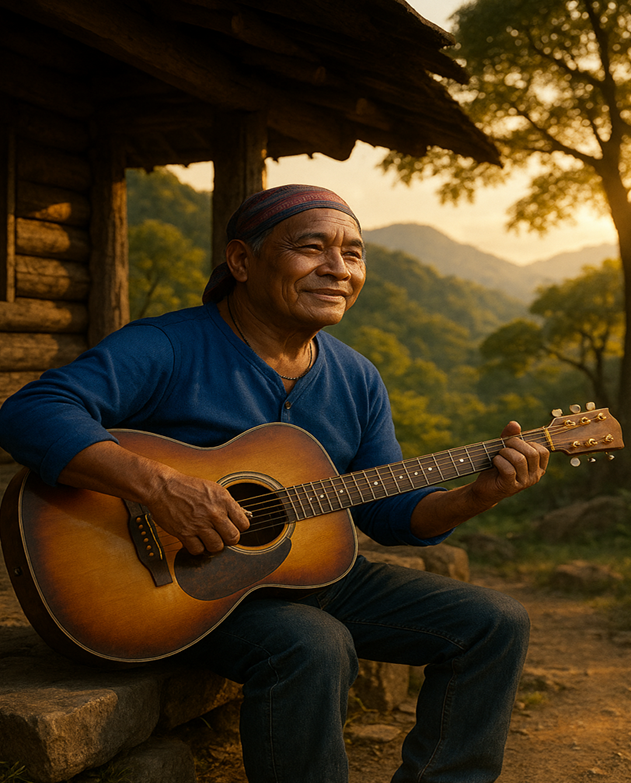
My father is a Paiwan from Mudan Township in Pingtung. He was born in 1959 and is now already in his “young old age,” in his late sixties. By legal definitions, he is considered an elderly person; but in my eyes, he will always be that confident, guitar-carrying, proud yet lovable dad who smiles with ease.
My father is the fifth child in the family, the youngest. According to traditional Paiwan beliefs, the youngest child is often the one who is most cared for. However, in a time of material scarcity, being “cherished” did not mean life was easy. My father often says that just seeing taro or sweet potatoes makes him nauseous, because he ate them every day as a child, so much that he grew afraid of them. Every time he says this, I laugh, and so does he, but his smile always carries the hardship of that era.
I enjoy talking with my father, especially about his childhood and stories from the tribe. Perhaps because I am Indigenous myself, I long to understand my roots. My father seems to have silently taken on this role, becoming my family historian and my teacher of tribal language and culture.
He often tells me that children in his time were not allowed to speak their own language. In primary school, speaking the tribal language meant punishment. When he speaks of the pain of having culture forcibly suppressed, he does not complain much. He simply says one Paiwan word, “tjakudain,” filled with helplessness.
Every time I hear that word, I think of today’s discussions about multiculturalism and language revitalization. Looking back at my father’s experiences, my heart feels heavy.
Because educational resources were limited, he went up to the mountains to do farm work after graduating from junior high school. He describes that period lightly, but I know it could not have been easy.
When he talks about guitar and music, however, his eyes light up. He says he started playing the guitar in junior high school because he “wanted to look cool in front of girls.” I believe him completely. My dad really does care about appearances, and he naturally carries a sense of performance and presence.
After completing military service, he left the tribe to work in the city. Life was not easy for Indigenous people at that time, and he said that when he first arrived in the city, he often felt looked down upon.
His jobs were all physically demanding and required long hours. He started as a carpenter, and later worked in construction formwork; a line of work he stayed in for his entire life. Sweat, sun exposure, and roughened hands were the path he carved out for his family.
Later, through singing and playing the guitar, he met my mother. The two quickly met, fell in love, married, and had my older brother and me. He was in his thirties then, brave and impulsive, boldly turning a new page in his life.
Even after moving to northern Taiwan, he never forgot his roots. When I was young, he often brought us back to the tribe and introduced us proudly, saying, “These are my sons.” At that moment, he stood tall, his eyes shining with pride; as a man, a father, and a member of his people.
He is someone who appears tough on the outside but is soft-hearted within. Proud, yet deeply affectionate.
Time passes quickly, and my father has become a “young old person.” I once asked him whether he wanted to return to the tribe. He always replied, “I’m not that old yet. I don’t want to go back.”
I know this is not simply refusal. It is a resistance to aging, and perhaps also an awareness of the lack of resources and limited social interaction back home, a fear of becoming trapped there. He says that many people there drink and pass time away, and that “you’ll die too quickly.”
Yet I know that deep down, he still misses those mountains, that group of friends, and that chapter of youth.
Even now, he insists on continuing to work and still rents a place to live. Watching him grow older day by day, I worry what if he has no home of his own, what if the landlord no longer rents to him, where will he live in the future?
Issues of housing in old age are no longer just topics in textbooks; they are realities that our family will inevitably face.
I once asked him, “When you retire, do you want to go back to the tribe?”
He shook his head. “I can still work. I don’t want to go back.”
His answer is both brave and stubborn, a kind of obstinacy that belongs to men, and to his generation.
I do not force him. I only hope that he lives happily.
He has also said that life in the past was too hard. He does not want to look back. The only person he truly misses is his mother, my grandmother, a woman who single-handedly held the family together and raised her children in times of severe scarcity.
That resilience is my father’s deeply hidden gratitude, and also the softest part of his life.
I asked him one last question: “Is there any dream you haven’t fulfilled yet?”
He laughed and said, “Go join a singing competition. I don’t want regrets.”
I thought about that sentence for a long time.
Perhaps this is what living is like.
Even when life does not go as hoped, a person should keep a small dream to remind themselves that they are still moving forward, still hoping, still alive.
Watching my father, I have learned that growing old is not an exit from life, but a practice in living more freely.
Maybe one day he will return to the mountains, or maybe he won’t. That is his rhythm, his choice.
And as for me, I only hope that I can stay by his side and watch him shape the rest of his life into the way he wants it to be.
我爸爸是屏東牡丹鄉的排灣族人,民國48年出生,現在已是六十好幾的「年輕老人」。
在法律定義裡,他算是老年人;但在我的眼中,他永遠是那個帶著吉他、笑起來很自信、愛
面子又可愛的爸爸。
爸爸在家中排行老五,是家中的老么。照傳統排灣族觀念,老么是被呵護的角色,但在那
個物資匱乏的年代,「被疼愛」不代表生活輕鬆。爸爸總說,他看到芋頭跟地瓜就反胃,因
為小時候天天吃、吃到怕。每次聽到這裡我都會笑,他也笑,但笑裡帶著那個年代的苦。
我喜歡跟爸爸聊天,尤其是關於他的童年和部落故事。
可能是因為身為原住民的我,也渴望理解自己的根。爸爸也像是默默接下這份任務,成了
我的家族歷史老師和族語文化老師。
他常告訴我,那年代的孩子不能說自己的語言。國小時,只要說族語就會被罰。那種文化
被強迫壓抑的痛,他沒有太多抱怨,只有一句族語:「tjakudain」無奈。
每次聽見這句,我都會想到現在社會談多元文化、族語復振,再回顧爸爸的經歷,心裡很
酸。
因教育資源有限,他國中畢業後就到山上做農事。那段日子,他形容得很簡單,但我知道
那絕不簡單。
倒是談到吉他和音樂,爸爸的眼睛會亮起來。他說國中就開始彈吉他,因為「想在女生面
前耍帥」。這點我完全相信因為我爸真的很愛面子,而且自帶舞台感。
退伍後,他離開部落到城市工作。那時的原住民處境不容易,他說剛到都市時常感受到被
看不起。
他的工作都是高勞力、長工時的行業先是木工,後來做營建板模,一做就是一輩子。
汗水、日曬、粗糙的手,那是他為家庭打出的路。
後來,因為唱歌跟吉他,他遇見了我媽媽。兩人很快認識、相愛、結婚,生了哥哥和我。那
時他三十多歲,勇敢而衝動地在人生裡翻開一頁新的篇章。
雖然搬到北部生活,他沒有忘記自己的根。我還小時,他常帶我們回部落,介紹我們:「這
是我的兒子們。」那時候的他,站得筆直、眼睛閃亮,帶著一份身為男人、父親、族人的驕
傲。
他是那種看似強硬、其實心很軟的人。愛面子,卻也深情。
時間過得很快,我爸成了「年輕老人」。我問他會不會想回部落,他總說:「我還沒那麼老,
不想回去。」
我知道那不只是拒絕,而是一種不服老,也可能是看見家鄉資源缺乏、社會互動有限,怕
自己陷進去。他說那裡很多人喝酒、消磨時間,「太快就會死」。
但我知道,他心裡還是想念那片山、那群好友、那段青春。
現在的他還堅持工作、還租房生活。看他一天天老去,我會擔心沒有自住房、房東是否願
意繼續租、未來住哪裡?
老年居住議題,不再是書本上的討論,而是我們家遲早會面對的現實。
我問過他:「退休了想回去部落嗎?」
他搖頭:「我還能工作,不要回去。」
他的回答既勇敢又固執,是那種屬於男性、屬於那一代人的倔強。
我不強求。我只希望他過得開心。
他也說過:以前的日子太苦,他不想回頭,只想念他的母親我奶奶,一個獨自撐起全家、在
缺乏資源時把孩子們拉大的女人。
那種堅韌,是父親深藏的感謝,也是他生命裡最柔軟的地方。
我最後問他:「有什麼夢想還沒完成?」
他笑說:「去比歌唱比賽吧,不想遺憾。」
那句話我聽了很久。
或許,活著就是這樣吧
儘管生活不總如願,但人要留一個小小的夢,提醒自己還在走、還在期待、還在活。
看著爸爸,我學到,變老不是退場,而是練習活得更自在。
也許某一天,他會回到山上,也許不會,但那是他的節奏、他的選擇。
而我,只希望自己能陪在他身邊,看他把餘生活成他想要的樣子。