
Author: Pan Wen-Hui 潘玟卉
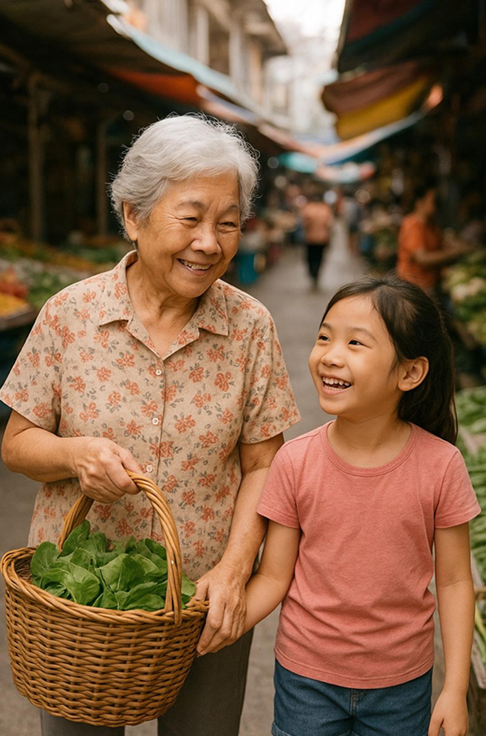
My memories of Grandma are always tinged with a sense of warmth and gentle blur. She passed away when I was in the third grade of elementary school. At that time, I did not really understand what “a final farewell” meant. I only remember that the atmosphere at home felt very different during those days, everyone spoke less than usual. It was only as I grew older that I gradually came to understand how profound that period was for me. I was almost entirely raised by Grandma. When I was young, my parents were busy with work and also had to take care of my younger siblings, so it was Grandma who brought me up.
Grandma was not tall. She had fair skin, and the corners of her eyes always carried smiling lines. She loved speaking in Taiwanese; it was the language that came most naturally to her. Under her guidance, I spoke Taiwanese very fluently as a child. My favourite thing to do was to go to the market with her. It was our “routine activity” every weekend morning, and also the most vivid scene in my childhood memories. At dawn, Grandma would carry her vegetable basket and call out to wake me up, “Grandchild, let’s go to the market!” I would always excitedly hold her hand and follow behind her, watching as she weaved through the alleys, her steps slow yet rhythmic.
The market was filled with lively sounds. Vendors calling out one after another, the air mixed with the fresh green scent of vegetables, the savoury aroma of dried tofu, and the warmth of freshly fried youtiao. At every stall, Grandma would greet the vendors, chatting in familiar Taiwanese: “Are the vegetables fresh today?” “Boss, weigh two pieces of that soft tofu for me.” Her voice was gentle, yet it made people feel especially at ease.
I loved walking beside her, watching how she chose vegetables, and she would always ask me what I wanted her to cook for me. Sometimes, Grandma would take me to a vegetarian stall run by a Taoist friend of hers. They sold mushroom vermicelli stew, which remains the most delicious vegetarian vermicelli dish in my memories.
On the way home after the market, Grandma carried a very heavy basket of groceries, yet she never let go of my hand. I would help her carry the day’s “spoils.” As we walked, she would talk in Taiwanese about what she planned to cook: “Stir-fried vegetables for lunch, tofu soup for dinner.” These conversations were simple but full of warmth, and they made me feel that Grandma was an excellent cook. Even now, whenever I pass by a market, I still go to eat that familiar vermicelli. In front of my eyes, Grandma’s silhouette always appears, the figure carrying a basket, smiling as she chatted with others—like sunlight, forever staying in my heart.
Later, after Grandma passed away, I returned to live with my parents. I spoke Taiwanese less and less, and gradually it became a language I could understand but not speak fluently anymore.
However, whenever I hear elders speaking Taiwanese, a sense of familiarity arises in my heart. It is a feeling of belonging, as if Grandma is once again by my side, speaking with me. Now I understand that language is not merely a tool for communication, but a bridge of emotions. The reason I can speak Taiwanese is because it is a language of love, a gift Grandma taught me. She taught me to listen with my heart, to respond with gentleness, and to express love through the small moments of everyday life.
Grandma has been gone for many years, yet I still remember her smile and those eyes that were always filled with kindness. She was the first person in my life to love me, and she is also my most unforgettable memory.
In my heart, she is still sitting on that old wooden chair, smiling at me, speaking in Taiwanese:
“Grandchild, you’re back. Time to eat.”
我對奶奶的記憶,總是帶著一種溫暖又模糊的記憶。她在我國小三年級那年離
開人世,那時我還不太懂什麼叫「永別」,只記得那幾天家裡的氣氛很不一樣,
每個人都不太說話。直到後來長大,我才慢慢明白,那段時光對我的意義有多
深——因為我幾乎是奶奶一手帶大的孩子,小時候因為爸爸媽媽工作忙,又有
弟弟妹妹要照顧,因此奶奶照顧我長大。
奶奶個子不高,皮膚白白的,眼角永遠帶著笑紋。她說話時總愛用台語,那是
她最自然的語言。小時候的我在她的訓練下,台語說得很流利,也最喜歡做的
事,就是跟奶奶一起去逛市場。那是每個週末早晨的「例行活動」,也是我童
年記憶裡最鮮明的畫面。天剛亮,奶奶就會提著菜籃,喊我起床:「阿孫,
走,去市場!」我總是很興奮地牽著她的手跟在她後頭,看著她穿梭在巷弄
間,腳步雖慢卻有節奏。
市場裡的聲音很熱鬧,攤販此起彼落地叫賣,空氣中混著蔬菜的青味、豆干的
鹹香、還有現炸油條的熱氣。奶奶走到每一攤都會打招呼,用熟悉的台語和老
闆閒話家常:「菜今仔日新鮮無?」「老闆,彼個嫩豆腐秤我兩塊。」那語氣
柔柔的,卻讓人聽了特別安心。
我最喜歡跟在她身旁,看她挑菜的樣子,還會問我想吃什麼菜煮給我吃。有時
候,奶奶會帶我去吃素食攤。那攤位是她信道教的朋友開的,賣的是香菇麵線
羹,那是我回憶裡最好吃的素食麵線。
逛完市場的路上,奶奶提著很重的菜籃,手卻從不放開我,我也會幫她拿今天
的戰利品。她一邊走,一邊用台語說著今天要煮什麼:「中午炒青菜,晚上煮
豆腐湯。」那樣的對話簡單卻溫暖,覺得奶奶很會煮飯。現在每次經過市場,
我仍會去吃到那熟悉的麵線味道。眼前總會浮現奶奶的背影,那個提著籃子、
笑著和人聊天的身影,像陽光一樣,永遠留在我心裡。
後來因為奶奶過世,我也回到家中和爸爸媽媽一起生活,越來越少講台語,台
語也變成聽得懂但不太會說,就是不輪轉~
但聽到長輩用台語講話,心裡有種熟悉感。那是一種熟悉的歸屬感,好像奶奶
又在我身邊,和我一起說話,如今我明白,語言不只是溝通的工具,更是情感
的橋樑。我能說台語,是因為那是愛的語言,是奶奶教給我的一份禮物。她教
我用心去聽,用溫柔去回應,用生活的小事去表達愛。
奶奶走了這麼多年,我依然記得她的笑容,那雙永遠帶著慈愛的眼睛。她是我
生命裡第一個愛我的人,也是我最難忘的回憶。
在我心裡,她依然坐在那張老木椅上,對我笑著,用台語說:「阿孫,返來啊,
食飯囉。」