
Author: Lin Guotai 林國泰
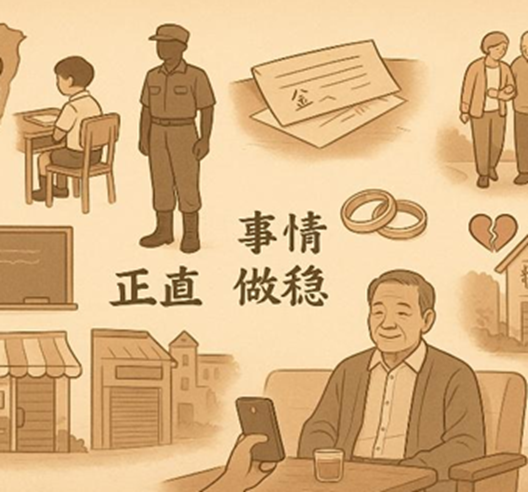
My dad was born in 1955, part of the postwar baby-boom generation. He often says he was fortunate: there were many elders in the family, and neighbours looked out for one another. Although they weren’t wealthy, there were people who cared and people who helped, and that alone kept the heart from panicking. This underlying feeling, “as long as someone is there, I feel at ease”, has, in fact, influenced him ever since.
At school, Dad was the type whose grades were “pretty okay”, not top of the class, but never at the very bottom either. What elders and teachers told him was simple: be upright as a person, and do things steadily. No long sermons, just those two lines. But said often enough, they sink into your bones (simple things are sometimes the hardest to forget).
During his time in the military, what Dad learned were rules and how to shoulder responsibility together. Beds had to be made, shoes polished, tasks completed. Standing guard, sweating, rotating duties. These things grind a person into something steadier. Later, when I watched how he worked, there was a kind of unhurried rhythm about him; it was probably forged back then.
After discharge, he entered the workforce. When he received his first pay check, he handed part of it back home first (a little nervous, and a little proud). At the beginning he didn’t understand much, so he swallowed his pride and asked questions. Seniors were actually very willing to teach, as long as you were willing to work and kept a humble attitude. This has been useful to me: if you don’t know, ask; once you ask, there’s usually a way forward.
After starting a family, the rhythm changed completely. Dad says that after work, when he gets home and checks whether the children are asleep, and there’s a pot of soup in the kitchen, his heart settles. It’s not that our home never argued, we did (which family doesn’t). But after an argument, you finish saying what needs to be said, and the next day you still eat together and carry on together. This ability to “take daily life back” might be more important than any elaborate apology.
Dad also started a business once. He was young, after all, and wanted to give it a shot. The economy rose and fell; plans were revised again and again. In the middle of the night, he would ask himself, “What am I even doing?” But the next day he still opened the door and answered the phone (that image is very vivid to me). In the end, he chose the right moment to stop and closed the company himself. You have to dare to go up, and also dare to come down; wins and losses are both tuition. This is the line he’s said that feels most “like a dad.”
About marriage, he’s very candid. His first marriage reached a point where the two of them thanked each other properly and said goodbye properly, without forcing a verdict of who was right or wrong (sometimes fate has simply reached the station). Later he entered a second marriage and built a home again. This time, he says he learned to listen more and show off less strength; a home needs space so people can turn around within it. I remember this idea of “leaving space” very clearly, because a home isn’t only love. It also needs distance and room to breathe.
Looking back on his life, it really has been “bitterness and joy together.” There are moments when the health of relatives raises alarms, friends drift away, children suddenly grow up. Things that make you cry, and things that make you laugh. When something comes, you face it; when it passes, you let it go. Dad says this in a very ordinary tone, but I know it’s something he’s arrived at by walking through it again and again.
Now, Dad admits that his body moves more slowly, his memory occasionally knots, and his strength isn’t what it used to be. What he can do is live more regularly, keep moving, and see a doctor when needed (no bravado). The most important principle is simple: don’t add trouble for your children; if you can handle things yourself, do so. His wishes are not complicated either: family safe, mood cheerful; go out for a walk in the morning, close the doors and windows at night, this is already very good.
Writing this, I actually feel steadied. It turns out that the impressive life we imagine doesn’t have to be beautiful titles or dramatic stories; it’s about catching each day: going to work, coming home, speaking things through, sleeping, and doing it again tomorrow. Dad says he’ll keep himself cheerful. I want to answer him: we’ll live our own lives well, come home often for meals, and speak a few more honest words. As for the future, we’ll walk it slowly; as long as that table at home and that lamp is there, knowing you’re here, we won’t panic.
爸爸是 1955 年出生,戰後嬰兒潮那一代。
他常說自己算幸運:家裡長輩多、鄰里會互相
照顧,雖然不富裕,但有人疼、有人幫,心就
不慌。這個「有人在,就安心」的底色,後來
其實一直影響他。念書的時候,爸爸屬於「功
課還可以」那種,不是第一名,也不會掉車尾。長輩跟老師講的道理很簡單:做
人要正直、事情要做穩。沒有長篇大道理,就這兩句,可是講久了會進到骨子裡
(簡單反而最難忘)。當兵那段,爸爸學到的是規矩和一起扛事。床要疊、鞋要
擦、事情要做完,站哨、流汗、輪勤,這些都把人磨得穩一點。後來我看他做事,
有一種不急不徐的節奏,大概就是那時候練出來的。退伍進入職場,第一份薪水
拿到手,他先交一部分回家(有點緊張、也有點驕傲)。剛開始啥都不懂,就厚
著臉皮問,前輩其實很願意教——只要你肯做、態度放軟。這點我滿受用:不會
就問,問了通常就有路。成家之後,節奏整個改變。爸爸說,下班回家先看小孩
睡了沒,廚房有一鍋湯,心就安。家裡不是沒有吵架,有啊(哪個家沒有),但
吵完要把話說完,隔天還要一起吃飯、一起過。這種把日子「接回來」的能力,
可能比什麼華麗道歉都重要。爸爸也創過業。年輕嘛,想闖一次。景氣上上下下,
計畫改了又改,半夜會自問「我到底在幹嘛?」但隔天還是把門打開、把電話接
起來(這句我很有畫面)。最後他選在對的時機收手,自己關掉公司。敢上也要
敢下,輸贏都是學費——這是他講過最「像爸爸」的一句話。婚姻的部分,他很
坦白。第一段走到後來,兩個人好好道謝、好好說再見,沒有硬要誰對誰錯(緣
分有時候就是到站了)。後來進入第二段婚姻,家又搭回來。這次他說自己學會
多聽、少逞強,家裡要留空間,彼此才好轉身。這個「留空間」我很記得,因為
家不是只有愛,還有距離和呼吸。回頭看他的人生,真的就是「有苦有樂」。親
友健康偶爾拉警報、朋友有人走遠、孩子有時突然懂事——會讓人掉眼淚,也會
讓人笑出來。事情來就面對,過了就放下。爸爸講這句的口氣很平常,但我知道
那是一次次走過來的。走到現在,爸爸承認身體變比較慢、記性偶爾打結,力氣
不如從前。能做的,就是規律一點、動一動,該看醫生就看(不逞強)。最重要
的原則很簡單:不要給孩子添麻煩,能自己處理就自己來。願望也不複雜:家裡
平安、心情愉快,早上出去走一圈,晚上把門窗關好——這樣就很好。寫到這裡,
我其實被安定到了。原來我們想像中很厲害的人生,不一定是漂亮的頭銜或故事,
而是每天把日子接住:上班、回家、說清楚、睡一覺,明天再來一次。爸爸說他
會保持愉快,我也想回他:我們會把自己的生活過好,常回家吃飯,多講幾句實
在話。至於未來,就慢慢走;家裡那張桌子、那盞燈,知道你在,我們就不會慌。