
Author: Hou Yingxuan 侯盈瑄
I. Prologue
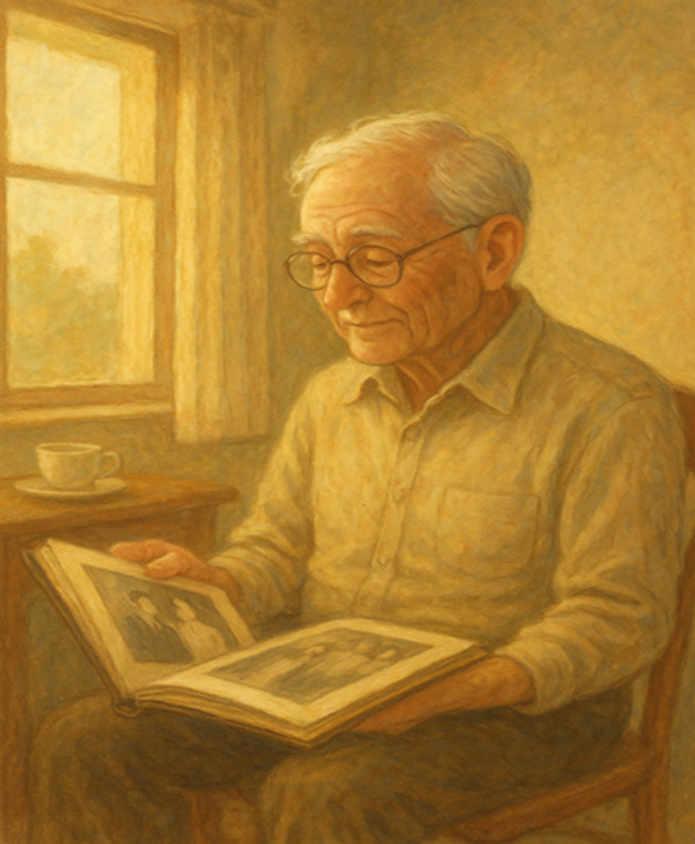
Grandpa Chen’s room is always bathed in the afternoon sunlight. A faded clock hangs on the wall, its hands always moving half a beat slower than time itself. He is already eighty-six years old. Walking now requires the support of a cane, yet every day he still insists on brewing a pot of oolong tea precisely at three o’clock.
As the aroma of tea fills the air, he opens the photo album that has been yellowed by time. With each page he turns, it feels as though he is opening a chapter of his life. In those photographs, there are smiles, tears, youth, and also moments of loss.
“Some of these people are still here, and some left long ago,” he murmurs to himself, his finger resting on a black-and-white photograph: a young man standing in front of a train station, beside him a brightly smiling girl.
II. Childhood Memories
Grandpa Chen was born in a small southern town in the 1940s. In those days, his family was poor. His father worked as a railway labourer, while his mother wove straw mats at home.
His clearest memory was that every time his father returned home, he would always carry a packet of biscuits in his hand. That was the most luxurious sweetness of his childhood.
The post-war years were marked by scarcity, yet he still carried a dream. “Someday, I want to go and see Taipei.” It was a place that felt distant, yet shone brightly in his heart.
III. Youth and Dreams
When he was seventeen, he carried a cloth bag sewn by his mother and boarded a northbound train. The first time he saw the dazzling neon lights of the city, he was so excited that he could not fall asleep.
He worked as an apprentice in a printing factory, his hands permanently stained black with ink. Life was hard, yet he felt that those days were the brightest moments of his life. It was also during that time that he met her: Lin Xiaomei, a typesetter at the factory. She loved to smile, and when she did, her eyes curved like crescent moons.
They often slipped away to the rooftop during lunch breaks to enjoy the view, talking about the future and their dreams.
“When we have money someday, let’s open our own little bookstore, okay?”
He remembers that the sunset that day was golden, and the breeze was gentle.
IV. Love and Family
Later on, they truly did get married. The little bookstore they dreamed of also became a reality. Though it was only a small shop near the market, four words hung on the wall “Mei Xiang Bookshop” written in her own handwriting.
Life was not wealthy, but it was steady and peaceful. They had two children, and the home was always filled with the scent of books and laughter.
Until one day, Xiaomei fell ill. The doctor said it was a brain tumor. That year, she was only forty-seven.
He has never forgotten the last words she said to him on her hospital bed.
“Old Chen, if one day I’m no longer here, promise me you’ll keep the bookstore doors open. As long as the books are here, it will be like I’m still here.”
He promised her and he truly kept that promise.
V. Loss and Learning
In the first few years after Xiaomei passed away, he sat almost every day at the entrance of the bookstore, saying nothing, simply watching the people passing by.
Until one day, a little girl began coming every day to borrow books. She said, “Grandpa Chen, the books in your shop smell so nice!”
He smiled. From that day on, he began actively helping children choose books, teaching them how to write, and telling them stories.
It turned out that companionship could also help a person learn how to smile again.
As time flowed on, the children grew up, and the bookstore was eventually demolished as part of an urban renewal project.
He took with him the wooden sign of Mei Xiang Bookshop, and the photo album.
VI. Reflection and Realisation
Now, he sits beneath the sunlight, turning the photographs one by one.
The photograph taken in front of the train station that year recorded the first long trip he took with Xiaomei. She was smiling brightly, while he looked tense and nervous.
He lets out a soft sigh and gently closes the album.
“In this lifetime,” he says quietly, “I didn’t become anyone important. But I have loved, and I have been loved. That is enough.”
The sunlight falls upon his deeply wrinkled face like a soft veil of gold. Outside the window, a gentle breeze lifts the album’s cover, revealing the final photograph.
Xiaomei in her youth, standing at the entrance of the bookstore, her smile unchanged.
一、序章
陳爺爺的房間總是灑滿午後的陽光,牆上掛著一面褪色的時鐘,指針總是慢半拍。他已
經八十六歲了,走路得靠著拐杖,但每天仍堅持在三點準時泡一壺烏龍茶。
茶香繚繞間,他打開那本被時間染黃的相簿。每翻一頁,像翻開了一段生命。那些照片
裡的他,有笑、有淚、有青春,也有失落。
「這些人,有的還在,有的早走了啊。」他喃喃自語,手指停在一張黑白相片上——一個
年輕男子站在火車站前,身旁是笑得燦爛的女孩。
二、童年記憶
陳爺爺出生在 1940 年代的南部小鎮。那時候家裡窮,父親是鐵路工人,母親在家織草
蓆。
他最清楚的記憶,是每次父親回家時,手上總帶著一包餅乾。那是他童年最奢侈的甜
味。
戰後的年代一無所有,但他仍懷著夢想——「以後要去台北看看。」那是他心中遙遠又閃
亮的地方。
三、青春與夢想
十七歲那年,他帶著母親縫的布袋,坐上往北的火車。第一次看到城市的霓虹燈,他興
奮得睡不著。
他在印刷廠當學徒,手永遠被油墨染黑。生活辛苦,可他卻覺得那是他人生最亮的時
光。也是在那段日子,他遇見了「她」——廠裡的排版員林小梅。她愛笑,笑起來眼睛會
彎成月亮。
他們常在午休時偷溜到屋頂看風景,聊著未來、聊著夢想。
「等我們有錢了,就開一家自己的小書店,好嗎?」
他記得那天的夕陽是金色的,風很輕。
四、愛情與家庭
後來,他們真的結婚了。那家小書店也真的開了,雖然只是一間靠近市場的小店,但牆
上掛著「梅香書屋」四個字。那是她親手寫的。
日子不算富裕,但平凡得安穩。他們有兩個孩子,家裡總是充滿書香與笑聲。
直到有一天,小梅病倒了。醫生說是腦部腫瘤。那一年,她才四十七歲。
他從沒忘記她在病床上最後對他說的話——
「老陳,如果有一天我不在了,你要幫我把書店的門繼續開著,好嗎?書香在,就像我還
在。」
他答應了。也真的做到了。
五、失落與學習
小梅走後的前幾年,他幾乎每天都坐在書店門口,不說話,只看著門外的行人。
直到有個小女孩每天都跑來借書,她說:「陳爺爺,你店裡的書都好香喔!」
他笑了。從那天起,他開始主動幫孩子們挑書,教他們寫字、講故事。
原來,「陪伴」也能讓人重新學會微笑。
時間流轉,孩子們長大了,書店被都市更新計畫拆除。
他帶走了那塊「梅香書屋」的木牌,還有那本相簿。
六、回望與感悟
如今,他坐在陽光下,一張張翻著相片。
那年火車站前的照片,是他和小梅第一次出遠門的記錄。她笑得燦爛,而他一臉緊張。
他輕輕嘆了口氣,合上相簿。
「我這一生啊,沒有成為什麼大人物,但我有愛過,也被愛過。那就夠了。」
陽光落在他滿是皺紋的臉上,像一層溫柔的金紗。窗外的風輕輕掀起相簿的封頁,露出
最後一張照片——
是小梅年輕時在書店門口的樣子,笑容依舊。